


NGC 5139 - Omega Centauri Astrophotography

NGC 5139, much better known as Omega Centauri, is the largest known globular cluster in our Milky Way and an impressive target in the southern night sky. It is located in the constellation Centaurus, and is a huge ball of millions of stars packed tightly together. In this post, you will find information, images, and tips to help you photograph and process this incredible globular cluster.
Object Designation: NGC 5139, Caldwell 80, Melotte 118
Also known as: Omega Centauri
Constellation: Centaurus
Object Type: Globular Cluster
Distance: 17,000 light-years away
Magnitude: 3.9
Apparent Size: 36'
Discovery: Registered in 1677 by Edmond Halley
The Omega Centauri is one of the best astrophotography targets of the southern hemisphere. Unfortunately, it is not easily shot from my location in the North, so I used telescope.live to get the data and processed it myself. If you want to also download it or get other targets, you can use the coupon code TL4GH to get your first month free!
NGC 5139 Astrophotography of the Omega Centauri Cluster
October 2026
The constellation Centaurus is impossible to see from my latitude in the north of France, so I had no choice but to figure out another way to capture this target.

The data was taken from the very dark skies of Australia, using telescope.live.
The telescope is a Takahashi FSQ-106ED and the camera is a QHY600M (not pictured here).
Below you can see the result, with a total of 7 hours and 25 minutes of total integration time. It was very fun to work on, and you can even see faint IFN on the side! I show you exactly how I processed this from start to finish in my Cluster PixInsight Processing Guide.
Click the image to see it in high-resolution!

Would you like to process this data? Get a free stack on Telescope Live!
GEAR USED:
Camera: QHY600M
Telescope: Takahashi FSQ-106
Observatory: Australia
Processing: PixInsight (Watch tutorial)
ACQUISITION DETAILS:
Total Exposure Time: 7 hour and 25 minutes
Exposure Time per frame: 5 minutes
Filters: L/R/G/B
How to find the Omega Centauri Cluster?

Omega Centauri can be found in the constellation Centaurus in the southern sky.
Because it is extremely bright for a globular cluster, Omega Centauri is actually one of the easiest deep-sky objects to find once the sky is fully dark. When far from light pollution, it will look like a fuzzy patch of light.
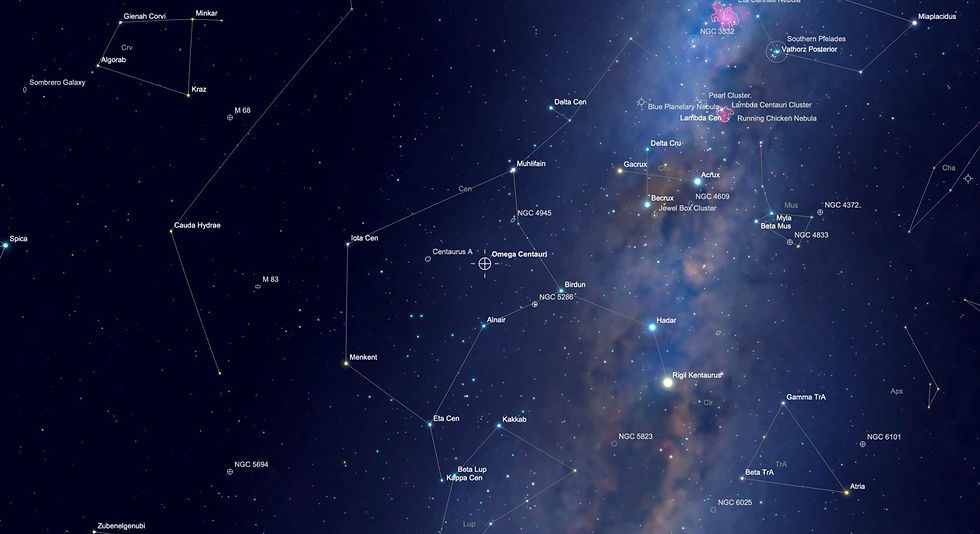
One of the easiest ways to locate it is by using the bright southern stars of Centaurus as reference points. From Alpha Centauri, you can work your way south toward the region of the constellation where Omega Centauri is located.
Omega Centauri is very close to the Centaurus A galaxy (NGC 5128).
Omega Centauri by NASA and the Hubble Space Telescope
Omega Centauri was photographed by NASA and ESA using the Hubble Space Telescope. Because of its size, only the central region can be seen in the final image. You can see millions of stars in just this small portion of the cluster.

Globular clusters usually contain very old stars that formed around the same time, Omega Centauri has multiple stellar populations with different ages. Because of this, some astronomers believe that Omega Centauri might actually be the remnant core of a dwarf galaxy that was disrupted and absorbed by the Milky Way.
Online Premium Astrophotography Course
Want to learn all aspects of astrophotography in the most efficient way possible?

The Galactic Course includes access to all our astrophotography courses, processing guides, and downloadables. Step into an ever-growing realm of knowledge and learn at your own pace. Make life-long friends and connections with other members, and get tips from instructors that truly care about your journey and progress under the night sky.
Processing Omega Centauri on PixInsight
Processing a globular cluster like Omega Centauri is very different from processing a galaxy or nebula. There is no large cloud of gas to reveal, no faint Ha structures to bring out, and no background dust to balance. Instead, almost the entire image is made up of stars... although in this case, there is dust!

The first challenge was of course star management. Omega Centauri has so many stars that the core is very dense. If you push the image too hard, the stars will merge together without you realizing, and the core loses all definition. For that reason, I was very careful with every step to make sure the stars weren't getting messy, and removed them.
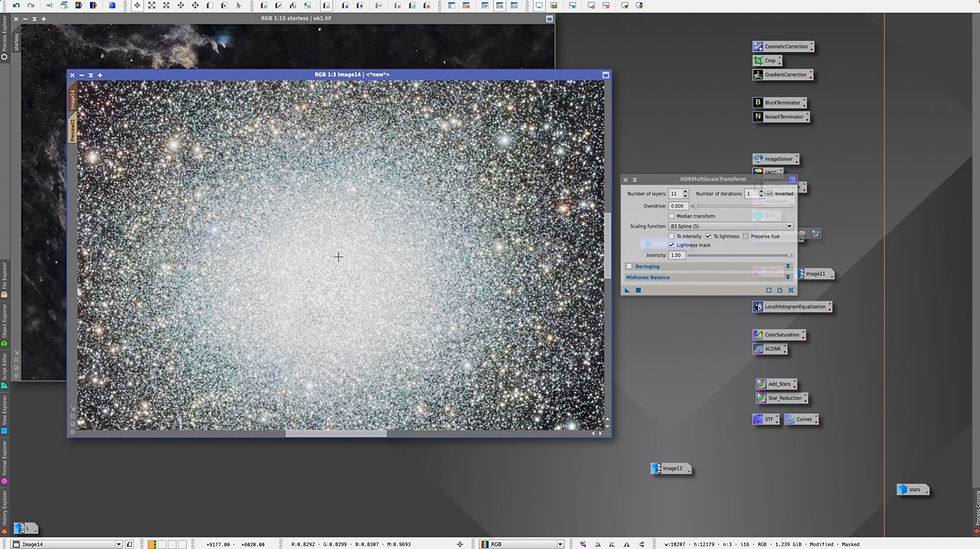
I was also paying attention to the core, which had to be protected when needed. Lastly, the colors had to be natural and look good overall.
I show you how I process this exact target step by step in my Cluster Processing Guide. It includes several different case studies that cover different types of star clusters.
NGC 5139 FAQ
In which constellation is NGC 5139 located?
You can find the Omega Centauri Cluster in the constellation Centaurus.
How big is NGC 5139?
Omega Centauri has a diameter of approximately 150-450 light-years (depending on how you define its boundaries). From Earth, it has an apparent size of 36.3 arc minutes.
Can I see Omega Centauri with the naked eye?
Yes, from a dark site, you should be able to spot Omega Centauri without a telescope or binoculars.
How old is Omega Centauri?
NGC 5139 is 10-12 billion years old, but may contain several generations of stars.
How far is NGC 5139?
Omega Centauri lies approximately 17,000 light-years away from Earth.
How long should my exposure times be when photographing NGC 5139?
I suggest 30 seconds for all globular clusters with a bright core like this one!
Should I use a filter to image Omega Centauri?
No, Omega Centauri is a great broadband target, so simply shoot it with your color camera without a filter. If you use a mono cam, shoot it in R, G, and B (+ L if you want).
Omega Centauri Processing Video Tutorial
You can learn how to process this target and many other clusters with the Galactic Course's Cluster Processing Guide. It includes text lessons, tutorial videos, our custom process icons, raw data, and more! The course is updated whenever I decide to tweak my workflow or add more to it, and you always get the updates for free! Several additional "Case Studies" show you how to process various clusters from start to finish.

Other processing guides are available for galaxies, nebulae, comets, and smart telescopes. You can also get the Processing Bundle to get them all at once!
Final Thoughts
I'm happy with this image of Omega Centauri, and I enjoyed processing it!
I would like to thank Telescope Live for the opportunity of getting access to this high-quality data of a target I physically cannot shoot from my location. If you'd like to get some yourself, you can use the coupon code "TL4GH" to get 50% off your first 2 months (AKA one full month free)!

Have you captured Omega Centauri? Attach your image in the comments and let us know your acquisition details!
Clear Skies,
Galactic Hunter
GALACTIC HUNTER BOOKS
Description: Discover 60 Deep Sky Objects that will considerably improve your Imaging and Processing skills! Whether you are a beginner, intermediate, or advanced astrophotographer, this detailed book of the best deep sky objects will serve as a personal guide for years to come! Discover which star clusters, nebulae, and galaxies are the easiest and most impressive to photograph for each season. Learn how to find each object in the night sky, and read our recommendations on imaging them in a quick and comprehensive way. Each target in this guide contains our advice on imaging, photos of expected results, and a useful information table. We've also included a few cool facts about each target, a map to find it in the night sky, and more!
Description: The Astrophotographer’s Journal is a portable notebook created for the purpose of recording observations, cataloguing photographs, and writing down the wonderful memories created by this hobby. This book contains more than 200 pages to memorialize your stargazing and imaging sessions, as well as a useful chart on the last pages to index exciting or important notes. Read back on the logs to see how much progress you have made through the months, the problems you overcame, and the notes taken to improve in the future. Just as the pioneers of astronomy did in their time, look up and take notes of your observations as you are the author of this star-filled journey.
Description: The Constellations Handbook is a logical guide to learning the 88 constellations. Learning the constellations is difficult. Remembering them is even harder. Have you ever wanted to look up to the night sky, name any pattern of stars and be able to tell their stories? This book groups the constellations in a logical order, so that the reader can easily learn them by their origin, and see how their stories interact with one another as a group. The last pages of this book include an index of all 88 constellations, each with a slot where you can write your own personal tips and tricks in order to memorize them with ease. The Constellations Handbook is not just another guide listing all the constellations from A to Z and their location, it is the perfect companion for stargazing, and a learning journey through the ages.


Comments