


M25 - Open Cluster in Sagittarius | Astrophotography

Messier 25 is an open cluster in the constellation Sagittarius. It’s a fun target to photograph because it lies on top of some dark Milky Way dust. In this post, you will find information, images, and tips to help you photograph this star cluster.
Object Designation: M25, IC 4725
Also known as: N/A
Constellation: Sagittarius
Object Type: Open Cluster
Distance: 2,000 light-years away
Magnitude: 4.6
Discovery: Philippe Loys de Chéseaux, 1745
Messier 7 is a very good target for beginner astrophotographers, thanks to its brightness and size. Although it is easy to capture with almost any setup, revealing the faint background gas and surrounding dust clouds can be a bit challenging, especially during processing.
In the northern hemisphere, Messier 7 rises high in the sky during July and so it is best photographed in the Summer season.
Messier 7 Astrophotography in the Milky Way band
July 2025
I spent 10 hours shooting M25 using my fast RASA 8 telescope from the Bortle 1/2 skies of New Mexico. I decided to stop after 10 hours because I thought it was enough for this region of the sky. I wonder if doubling or tripling this integration time would have revealed more, but I'm overall very happy with the result. It looks nice, impressive, yet clean and simple.
Some dark dust lanes are visible, especially near the bottom left of the image. The cluster is not extremely bright or impressive, but has a beautiful shape.
Click the image for the full-resolution version!

GEAR USED:
Camera: ZWO ASI2600MC
Telescope: Celestron RASA 8
Mount: 10Micron GM2000 HPS
Guiding: ZWO ASI 220MM Mini
Accessories: Celestron Focuser / PrimaLuceLab Eagle 5S
Processing: Pixinsight, with R-C Astro plugins. Final touches in Skylum Luminar Neo
ACQUISITION DETAILS:
Total Exposure Time: 10 hours
Exposure Time per frame: 300 seconds
Filters: N/A
Gain: 100
How to Find the Messier 25 Cluster
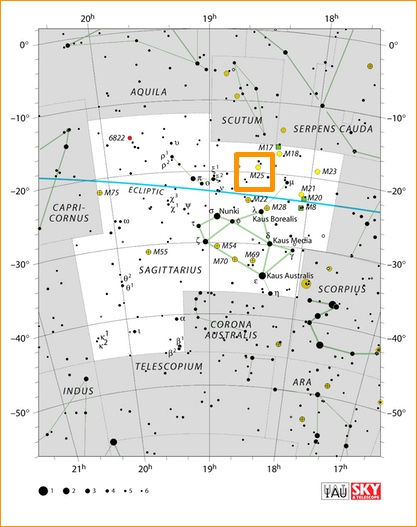
Messier 25 is an open cluster located in the constellation Sagittarius. It is a rich grouping of stars close to the Milky Way band area. It is not as famous as some of the other nearby deep sky objects, but it's still a great target to shoot!
To find Messier 25, first look for the constellation Sagittarius, which you can easily spot by its famous "Teapot" shape. Look toward the northern part of the constellation, above the star Kaus Borealis. Messier 25 can be found a few degrees northeast of this star and appears as a loose concentration of stars within the Milky Way.
M25 is about 32 arc minutes wide, making it slightly larger than the apparent size of the full Moon. Under dark skies, it can be detected with binoculars as a bright patch of blurry stars. A small telescope will reveal dozens of individual stars spread across the cluster.
Near Messier 25 you can find several other popular deep-sky objects, including M24 (the Sagittarius Star Cloud), M17 (the Omega Nebula), M18, and M16 (the Eagle Nebula).
The best time to observe and photograph M25 is in Summer.
Learn Astrophotography
Want to learn all aspects of astrophotography in the most efficient way possible?

The Galactic Course includes access to all our astrophotography courses, processing guides, and downloadables. Step into an ever-growing realm of knowledge and learn at your own pace. Make life-long friends and connections with other members, and get tips from instructors that truly care about your journey and progress under the night sky.
Processing M25
Messier 25 is not only easy for beginners, it's also fun. It's a great target to process because the stars in the cluster itself are well spread out that they don't really give any challenge, the background is even without too much nebulosity, and the thin dark lanes visible add a "spice" to the overall image.
Revealing the dark lanes is the most fun part, especially if it's your first time encountering those in your files.

Here you can see what a 300-second single shot looks like. The cluster is visible in the center, and the dark dust lanes can barely be seen in the bottom left.
If you'd like to learn how to process your images, get our astrophotography processing guides! They include written and video lessons, raw data, and straight to the point tips to help you get the best out of your images.
Messier 25 FAQ
In which constellation is M25 located?
You can find Messier 25 in the constellation Sagittarius.
How big is M25?
Messier 25 has a diameter of approximately 19 light-years. From Earth, it has an apparent size of 32 arc minutes.
How old is M25?
Messier 25 is 90 million years old.
How far is Messier 25?
M25 lies approximately 2,000 light-years away from Earth.
How long should my exposure times be when photographing M25?
I recommend between 300 seconds (5 minutes) and 600 seconds (10 minutes) which will give you great results especially if you're looking to get some nice signal overal and show the dark lanes very well.
Should I use a filter to image M25?
A broadband filter might help enhance the contrast and reduce light pollution if you are imaging from the city, but we wouldn't recommend using one. If you are imaging from a dark site, you will not need a filter since M25 is an open cluster and is just stars!
Final Thoughts
Messier 25 is a fun and easy cluster to photograph and process. It's a nice target during Summer nights if you want to tackle something simple before jumping back into the large and bright nebulae of the season!
Have you imaged the M25 cluster? If so, upload your picture in the comments! We'd all love to see your work :)
Clear Skies,
Galactic Hunter
GALACTIC HUNTER BOOKS


Comments