


M68 - The Hydra Globular Cluster With IFN | Astrophotography

Updated: Sep 15
Messier 68 is a large, ancient globular cluster in the constellation Hydra, one of the least concentrated clusters in our galaxy. It may not even be a native of the Milky Way as it might have belonged to a dwarf satellite galaxy that ours absorbed long ago. In this post, you will find information, images, and tips to photograph this beautiful star cluster.
Object Designation: M68, NGC 4590
Also known as: N/A
Constellation: Hydra
Object Type: Globular Cluster
Distance: 33,000 light-years away
Magnitude: 7.8
Discovery: Charles Messier in 1780
Messier 68 is easy to capture, but a little more complex to process depending on whether or not you want to include the IFN in there. Overall though, you can photograph this globular cluster with any gear without difficulty!
M68 gets high in the sky in April and so it is best photographed in the Spring season.
Messier 68 Astrophotography with IFN and other Gasses
April 2026
I decided to capture M68 for two main reasons:
I needed to add it to my Messier Catalog
I wanted a break from galaxies, which are all over the sky in Spring!
I spent 9 hours on this object, not expecting much, but was pleasantly surprised when I started processing the data. Once I stretched the image, a faint patch of IFN showed up hugging the top edge of the frame, and I shifted my whole workflow toward pulling that out as cleanly as I could.
Click the image for the full-resolution version!

GEAR USED:
Camera: ZWO ASI2600MC
Telescope: Celestron RASA 8
Mount: 10Micron GM1000 HPS
Guiding: ZWO ASI 220MM Mini
Accessories: Celestron Focuser / PrimaLuceLab Eagle 5S
Processing: Pixinsight, with R-C Astro plugins. Final touches in Skylum Luminar Neo
ACQUISITION DETAILS:
Total Exposure Time: 9 hours
Exposure Time per frame: 300 seconds
Filters: N/A
Gain: 100
How to Find the Messier 68 Cluster

Hydra may be the biggest constellation in the sky, but it's not the easiest to navigate by its own stars, so most people star-hop to M68 using the small neighbor Corvus instead.
Start by tracking down the small boxy shape of Corvus. The star at its southeastern corner is Kraz. From there, M68 is about 3.5° to the southeast, which is just a short jump from Kraz!
M68 has a diameter of 11 arc minutes and can be seen easily in 7x50 or 10x50 binoculars. It looks like a fuzzy smudge, like most other globulars, but it's still cool to spot. You'll only see individual stars with a big scope!
The best time to observe and photograph M68 is in Spring.
M68 Cluster Information
At 11.2 billion years old, M68 is among the oldest clusters known to us. For scale, our own sun has only been around for about 4.6 billion years. Its stars also run low on heavier elements compared to typical Milky Way stars, which is why there is a theory that M68 comes from a different galaxy instead of forming with ours.
The cluster is home to approximately 100,000 stars, among them about 250 giants and 42 confirmed variables. It has a diameter of 106 light-years across, and it's coming towards us at a speed of 112 km/s.
M68 by Nasa and the Hubble Space Telescope
The picture below was taken by NASA and the Hubble Space Telescope. It was released on July 30, 2012 and has a field of view of approximately 3.4 by 3.4 arc-minutes.
It shows all the individual stars in the cluster, with mostly white/blue-ish stars and a few large yellow stars. You can see that the core is loose compared to many other clusters.

This image combines visible and infrared light and was taken using teh Wide Field Camera of the HST. You can click the image to see it in full resolution on NASA's page!
Our Premium Astrophotography Course
Want to learn all aspects of astrophotography in the most efficient way possible?

The Galactic Course includes a membership that gives you unlimited access to all our astrophotography courses and processing guides. Step into an ever-growing realm of knowledge and learn at your own pace. Make life-long friends and connections with other members, and get tips from instructors that truly care about your journey and progress under the night sky.
The Hidden Gasses Behind M68
What really makes this M68 image interesting isn't the cluster itself, it's the faint IFN (really just interstellar dust) sitting along the top of the frame.
Most M68 photos show the cluster floating in an empty black sky, and that's the case for a lot of clusters, so I always enjoy pulling out some of the faint dust even if it means sacrificing a bit of quality in the cluster itself.
IFN around M68
IFN stands for Integrated Flux Nebula. I explain all about it in my IFN post and on the Galacitc Course. It is made up of mostly dust particles, with hydrogen, carbon monoxide, and a few other elements. It's not nebulosity, but rather just space dust. Unlike nebulae, IFN dust is not illuminated by specific stars but instead by the integrated flux of all of the stars in our galaxy. This is what makes IFN so faint and difficult to image. They not only require a very dark sky far from any light pollution to be visible in photographs, but also hours of total exposure time.
IFN is mostly present at high galactic altitudes, both to the north and the south celestial poles.
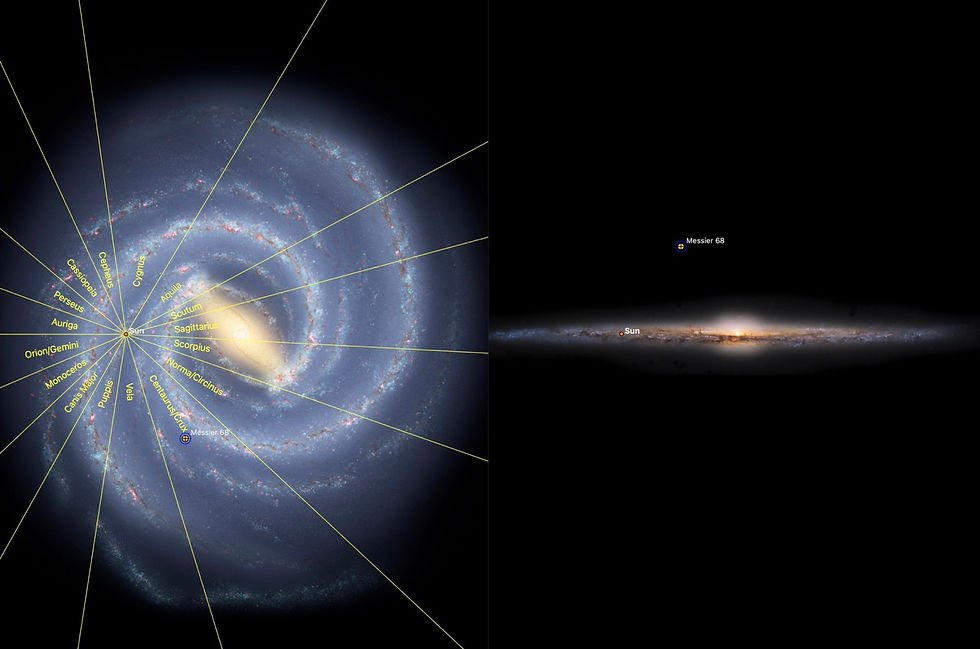
The screenshot taken from SkySafari shows you where M68 is located compared to our Milky Way. As you can see, it is very north of the galactic plane, where IFN is often present.
And below is my image without the stars, so that you can see all the sweet IFN present in it! It's not as much as M15, but still!

IFN is present around some other popular deep sky objects, such as:
How to Process M68 with IFN
Processing M68 was fun to process, and the difficulty greatly varies depending on whether you want to reveal the faint IFN or not.
If you do not care about the IFN, then processing the globular cluster itself is extremely easy! You just need to make sure you don't blow out the core when stretching and playing with curves. I also recommend protecting the clsuter with a mask if you are going to reduce the size of the stars near the end of your workflow.

If, like me, you intend on bringing out as much IFN as possible, then it gets more complicated! You'll have to use more masks, apply more noise reduction, and carefully use Curves Transformation several times to show the faint dust better and better.
Messier 68 FAQ
In which constellation is M68 located?
You can find Messier 68 in the constellation Hydra.
How big is M68?
M68 has a diameter of 106 light-years. From Earth, it has an apparent size of 11 arc minutes
How far is Messier 68?
M68 lies approximately 33,000 light-years away from Earth.
How long should my exposure times be when photographing M68?
To be safe, you can start with 30-second exposures, which is what I recommend for globular clusters as the stars are very packed and taking longer exposures means risking trashing several frames in case of wind of tracking issues. But if you also want the IFN, you can take much longer exposures, for example 300 or 600 seconds. You can then combine the short and long exposures together!
Should I use a filter to image M68?
This is a good broadband target, so no need for narrowband filters. The IFN is also good without filters. So either shoot with your OSC camera and no filters, or in LRGB!
What equipment do I need to photograph Messier 68?
You can photograph Messier 68 with any telescope. The size of the instrument you plan to use depends on what exactly you aim to capture. You can either use a large telescope and get a close-up shot of the cluster, or use a smaller instrument and get a wide-field view of the object which will allow you to include the IFN.
The telescope I used is the RASA 8 which has a focal length of 400mm. The RASA was very helpful in our mission to get the IFN because of how fast it is at f/2.
Final Thoughts
Messier 68 yet another underrated globular cluster. It is more exciting to shoot and process than most people think, thanks to the faint challenging IFN present nearby! It would also be a great object to capture with a large telescope, as I'm sure the close-up view would be excellent as well.

If you would like to learn how I process my cluster images, you can get my PixInsight processing workflow HERE. It includes text lessons, tutorial videos, custom process icons, raw data, and more! The course is updated whenever I decide to tweak my workflow or add more to it, and you always get the updates for free!
Have you imaged the M68 cluster? If so, upload your picture in the comments! We'd all love to see your work :)
Clear Skies,
Galactic Hunter
GALACTIC HUNTER BOOKS


Comments