


Planet Uranus: Facts, Rings, Moons, and Photography

Uranus is the seventh planet in order from the Sun. It is an ice giant with a pale blue-green atmosphere, dark rings, and a rotation that makes it look as though it is rolling around the Solar System on its side. It is about four times wider than Earth, but through a backyard telescope, it appears as a tiny dot due to its distance.

In this guide, you will learn what Uranus is made of, why it spins sideways, how its rings and moons were discovered, and what you can realistically see or photograph from Earth. You will also find images from Voyager 2, Hubble, and the James Webb Space Telescope, which show very different views of the same planet.
Uranus: The Sideways Ice Giant
Uranus sits between Saturn and Neptune. It is the third-largest planet by diameter, although Neptune contains more mass. Unlike the rocky planets closer to the Sun, Uranus has no solid ground where you could land a spacecraft and walk around.
Uranus and Neptune are classified as ice giants. That separates them from the gas giants, Jupiter and Saturn, whose main composition is hydrogen and helium. The word “ice” can be misleading though... Deep inside Uranus, the pressure and temperature are not like anything you would find in a freezer!
Who Was Uranus Named After?
Uranus takes its name from Ouranos, the Greek god of the sky.

William Herschel discovered Uranus on March 13, 1781, while observing from Bath, England. At first, he thought the object might be a comet. Further observations and calculations showed that it was a planet orbiting beyond Saturn, making Uranus the first planet identified with a telescope.
Herschel wanted to name it Georgium Sidus in honor of King George III. The name Uranus was suggested by astronomer Johann Elert Bode, and it ended up becaming the accepted choice. You can read more about the discovery in NASA’s Uranus exploration timeline.
Did you know? It is the only planet in the Solar System whose English name comes directly from a Greek deity rather than a Roman one.
Size and Mass

Uranus has an equatorial diameter of approximately 31,763 miles (51,118 kilometers), about four times Earth's. Its mass is about 14.5 times that of our planet. Uranus is therefore much larger than Earth, but less massive than Jupiter or Saturn.
There is an interesting distinction between size and mass here: Uranus is slightly wider than Neptune, but Neptune is heavier. A planet can take up more space without containing more material.
Distance from the Sun
Uranus orbits at an average distance of about 1.8 billion miles (2.9 billion kilometers) from the Sun, or approximately 19.2 astronomical units. One astronomical unit (AU), is the average distance between Earth and the Sun.
Sunlight takes about 2 hours and 40 minutes to reach Uranus. Its distance from Earth changes as both planets orbit the Sun.
Time, Rotation, and Orbit
How Long Is a Day on Uranus?
Uranus rotates once in about 17 hours and 15 minutes. A 2025 study using Hubble observations of its auroras (which is worth the read!) refined the interior rotation period to 17 hours, 14 minutes, and 52 seconds.
Measuring a day on an ice giant is complicated because you can't really just watch a continent or mountain or other distinctive feature rotate into view. Uranus has no visible solid surface, and its atmospheric features do not all move at the same speed. Tracking auroras tied to its magnetic field was the best way scientists could measure the interior rotation of the planet.
Why Does Uranus Spin on Its Side?
Uranus has an axial tilt of about 98 degrees. For comparison, Earth's tilt is about 23.4 degrees. Uranus is tipped so far over that its spin axis is almost in the plane of its orbit.

One possible explanation could be that a major collision early in the history of the planet occured, but this is still being studied.
Uranus also has retrograde rotation, similarly to Venus which is the only other planet described as rotating in the opposite direction to most of the Solar System.
How Long Is a Year on Uranus?
One orbit takes about 84 Earth years. If you celebrated birthdays once per Uranian year, you would be an elderly human before reaching your first birthday!

The combination of a long orbit and a sideways tilt creates extreme seasons. Each season lasts 21 Earth years, and the polar regions experience extended periods of daylight and darkness. This is very different from simply having a shorter day.
Can You See Uranus with a Telescope?
Yes, you can see Uranus with an amateur telescope... but there is a challenge! The tricky part is to be able to identify it among the background stars. Unlike many other planets, Uranus is not an obvious bright object in the sky.
Under a very dark, moonless sky, Uranus can be visible to the unaided eye near the limit of human vision. Binoculars make finding it more practical, although it generally looks like a faint star at low magnification. Through a telescope, the goal is to be able to spot the subtle blue-green color, which other stars don't have (unless you use a very low quality eyepiece!)
How to Find Uranus in the Night Sky
Just like the moon, deep sky objects, and other planets, it's best to observe when Uranus is high above the horizon.
Download a planetarium app like Stellarium or SkySafari. Add your actual location, and make sure the date and observing time are correct if they take from your phone/computer.
Compare nearby bright stars with what you see in the app and make sure you know which one is Uranus.
Start with a low-power eyepiece so you have a wider field of view.
Once you see it in the eyepiece of your telescope, increase the magnification gradually until you are happy.

Opposition is the best part of the observing season. At opposition, Earth is approximately between the Sun and Uranus, which makes the planet well placed for observing. Its exact constellation and observing dates change, so use a live app rather rather than a chart or online map from an old article.
What Does Uranus Look Like Through a Telescope?
Uranus will look like a tiny, blurry dot or disk depending on the magnification and aperture of your telescope. Its apparent diameter is only around 3 to 4 arc-seconds, so it is much smaller in the eyepiece than the beloved Jupiter or Saturn. The color will likely appear pale blue, greenish, or plain gray depending on the telescope and the atmospheric conditions.
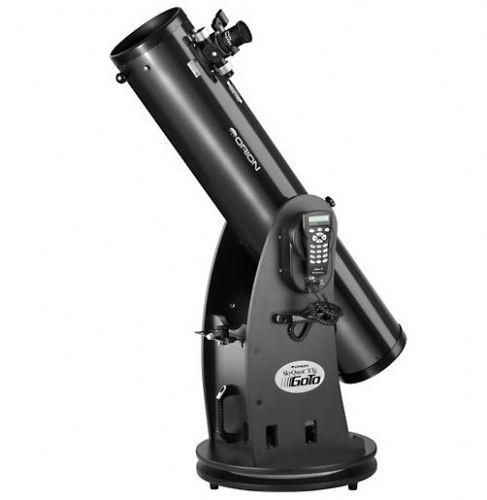
An 8 to 12-inch Dobsonian, like the type discussed in my Jupiter guide, gives you a very good starting point for visual planetary observing. Smaller telescopes can still show Uranus, but ones with larger apertures give you more light and resolving power.
Do not expect to see its rings as you would with Saturn. The brightest Uranian moons are also demanding targets, and the view will not look like anything from a space telescope image. If you can spot the small disk, it's already a worthwhile observation!
Can You Take a Picture of Uranus from Earth?
Yes, Uranus can be photographed from Earth despite looking very small and featureless. You will preferably want to use a long-focal-length telescope. There are two main approaches:
Single images: A DSLR or mirrorless camera attached to a telescope can capture Uranus. This is a fun picture to take if you are a beginner or don't own a larger telescope.
Video capture and stacking: Using a planetary camera, you can record many frames, which you sort and combine into one image. This is the more effective route for planets, in this case especially if you have a telescope with large aperture.
A few tips: Start by allowing the telescope to reach outdoor temperature, and make sure your collimation is good. Track the planet at its rate if your mount allows it, and focus carefully. Add a Barlow lens only when the extra image scale is useful, because spreading the same light across more pixels can make the planet dimmer for no good reason.

Uranus is faint compared to some other easier-to-capture planets, so choose settings that give a usable signal, then stack the better frames in planetary-processing software. Keep sharpening restrained since the planet doesn't show much detail anyway. Don't use AI to sharpen too much or it's just going to create features that aren't supposed to be there. A hard edge or a colored patch created during processing is not proof of a real feature.
If you have the skill and patience, you can do an HDR composition if you want to show the rings. This is doable if you take long exposures (3 minutes or more) of the planet, and only keep the rings, which you can then add to you regular picture from earlier. This Astrobin post will help you understand better!
Learn Astronomy and Astrophotography
Learn EVERYTHING about astrophotography with the Galactic Course! Check out the 1500+ lessons and get started on some of the free courses. Join thousands of other students, master you rig and stop wasting precious clear nights.

Rings of Uranus
Saturn is not the only planet with rings! Uranus has 13 known rings, although they are much darker and harder to see.
The rings were discovered on March 10, 1977, during a stellar occultation. Astronomers were watching Uranus pass in front of a star and noticed brief dips in the star's light before and after the planet blocked it. The material around Uranus was interrupting the light as well.
The rings have since been studied with Voyager 2, Hubble, and other observatories. Their names, moving outward from the planet, are Zeta, 6, 5, 4, Alpha, Beta, Eta, Gamma, Delta, Lambda, Epsilon, Nu, and Mu.

The bright rings in Webb's images are an example that the wavelength you observe (in this case, wavelength different than what you see through your backyard telescope) can change the view completely.
Planet Uranus History
Formation and Age
Uranus formed about 4.5 billion years ago from material in the disk of gas and dust surrounding the young Sun. Gravity brought material together as the planets grew. The planets were not formed from material expelled by the present-day Sun. Uranus may not have formed exactly where it orbits today.
Can Uranus Support Life?
No life has been detected on Uranus. Its atmosphere, temperatures, and insane pressures make it an inhospitable environment for life as we know it. There is also no solid surface where anyone could step foot.
Some of its moons, like Ariel, Umbriel, Titania, and Oberon could have oceans beneath their icy crusts. Possible liquid water makes these moons interesting to study, but of course nothing has been discovered so far.
Composition and Structure
What Is Uranus Made Of?
The visible atmosphere is mostly hydrogen and helium, with methane and other material. Deeper inside, it is believed that heavier material is present, described in terms of water, ammonia, methane, and rock.
Those ingredients are why Uranus is grouped with Neptune as an ice giant. They don't mean the planet is a solid ball of frozen water. At depth, high pressure and temperature change how the materials behave.

No probe has sampled the deep interior, so the precise proportions and internal arrangement are still uncertain.
Why Is Uranus Blue-Green?
Methane absorbs red wavelengths of sunlight in Uranus' atmosphere. The light that returns to space gives the planet a pale cyan appearance, with atmospheric haze also affecting the view.
A visible-light image and an infrared image will look very different without either being a mistake. The reason Uranus looks blue-green in pictures without a specific filter is because of methane in its atmosphere that is combined with a thick layer of aerosol haze.
What Is the Surface of Uranus Like?
Uranus does not have a solid surface like Mars. If a probe (or human) starts to descend through its atmosphere, you would find increasingly dense material, with rising pressure and temperature.

The dot visible from Earth is the atmosphere. It is not land hidden under a blue coating, and an “ice giant” is not a place where a lander could settle onto an icy plain. There is no confirmed solid ground.
What Is the Weather Like on Uranus?
The atmosphere of Uranus can reach temperatures as low as approximately -371°F (-224°C). This is a minimum measured in its atmosphere, not a uniform temperature throughout the planet. The deep interior is hot.
Uranus also has powerful winds, reaching about 560 miles per hour (900 kilometers per hour). Despite not showing it visually, it has a lot of clouds, storms, and seasonal changes.
A 20-year Hubble study released in 2025 tracked changes in haze and the brightening northern polar region. It also showed that methane is distributed differently near the poles.
NASA Space Telescope Images of Uranus
Uranus by the Hubble Space Telescope
This Hubble image shows rings, bright atmospheric features, and inner moons. The dots under the planet are not rows of different moons. They record the motion of Cressida, Juliet, and Portia in exposures taken several minutes apart.

Uranus by the James Webb Space Telescope
The Webb image shows the rings and was released on December 18, 2023. Its NIRCam instrument recorded near-infrared light. You can also see the nearby moons and the northern polar cap.

The colors are assigned to infrared filters so humans can see the data. This is not the same as taking a natural-color photograph with a regular camera. Use it to appreciate the rings and atmospheric structure, but don't expect to see the same through your own scope!
Learn the Constellations
Want to get better at finding constellations and exploring the night sky?
The Constellations Mastery Bundle brings everything together in one complete collection:
The Night Sky & Constellation Mastery Course: Learn how to navigate the night sky, find constellations, and explore interesting stars and deep-sky objects.
All 5 Constellation Reference Card Packs: Printable cards to learn spring, summer, fall, winter, and circumpolar constellations with practical guides to finding them and identifying their key stars and deep-sky objects.
The Constellations Handbook (PDF): Keep a digital reference guide handy as you continue learning about the night sky.

No matter if you’re a beginner or an experienced stargazer, this collection gives you everything you need to master the constellations all year long.
Missions to Uranus
Voyager 2: The Only Spacecraft Flyby

Voyager 2 launched on August 20, 1977, and reached Uranus on January 24, 1986. It is still the only spacecraft to have visited the planet at close range.
The spacecraft passed about 50,600 miles (81,500 kilometers) above the cloud tops. It returned close-up images, discovered 10 moons and two rings, and measured the planet's magnetic environment. It then continued to Neptune.
A Future Uranus Orbiter and Probe
The 2023-2032 Planetary Science and Astrobiology Decadal Survey recommended a Uranus Orbiter and Probe as a high-priority new flagship mission. A recommendation is not the same as a launched mission though, so officially there is no second Uranus spacecraft encounter to add to Voyager 2's visit yet.
The Moons of Uranus
NASA lists 29 officially recognized moons (as of late 2026). Most named Uranian moons come from characters in the works of William Shakespeare and Alexander Pope. The five major moons are Miranda, Ariel, Umbriel, Titania, and Oberon.

Miranda
Discovered by Gerard Kuiper in 1948, Miranda is the smallest and innermost of the five major moons. It is only about 500 kilometers across, but on the surfafe it has a mix of cliffs, ridges, and valleys.
Ariel
William Lassell discovered Ariel in 1851. Its bright surface is home to valleys and evidence of past geological activity. Ariel is also one of the moons considered a possible host for an internal ocean.
Umbriel
Lassell discovered Umbriel in the same year as Ariel. Umbriel is much darker, with a heavily cratered surface. One notable feature is a bright ring of material associated with the crater Wunda.
Titania
Titania is Uranus' largest moon, about 1,580 kilometers in diameter. William Herschel discovered it in 1787. Voyager 2 photographed long fault valleys cutting across its surface, which should mean that its crust has changed over time.
Oberon
Also discovered by Herschel in 1787, Oberon is the second-largest Uranian moon and the outermost of the main five. Its surface is heavily cratered, with some bright material and dark deposits visible in Voyager images.
These moons are difficult to observe from Earth, and their detailed pictures come from the Voyager 2 spacecraft.
Final Thoughts and Summary of the Planet Uranus
Uranus is of course much less impressive to observe through a telescope than Jupiter or Saturn, but it is rewarding to see! It's also a very challenging target for astrophotography if you plan on getting both the planet's natural color and the rings visible.

Type: Ice Giant
Name origin: Greek god of the sky
Discovery: March 13, 1781, by William Herschel
Equatorial diameter: 51,118 km (31,763 miles)
Mass: About 14.5 Earth masses
Temperature: About -224°C (-371°F)
Distance from the Sun: About 2.9 billion km (1.8 billion miles)
Day: 17 hours, 15 minutes
Orbit: About 84 Earth years
Axial tilt: About 98 degrees
Known rings: 13
Moons: 29
Sunlight travel time: About 2 hours, 40 minutes
Want to compare Uranus with the rest of the Solar System? Continue with my guides to Mars, Venus, Jupiter, Saturn, and Neptune.
Have you observed or photographed Uranus? Share what equipment you used and what you were able to see in the comments!
Clear Skies,
Galactic Hunter


Comments